

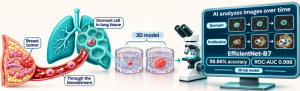
When Dormant Disseminated Cancer Cells Wake Up
One of the most challenging aspects of breast cancer is that cells can spread from the primary tumor to distant organs even at early stages of the disease. These disseminated tumor cells can remain dormant for years before resuming growth and potentially giving rise to life-threatening metastases. Understanding what drives this transition from dormancy to active growth is critical to developing strategies to prevent metastatic breast cancer recurrence.
But can artificial intelligence recognize the subtle biological changes that occur when dormant cancer cells become active again?
Our research explores this question by combining experimental cancer biology with advanced deep learning and computer vision techniques.
Our Research: Understanding Dormant Breast Cancer Cell Reactivation Through AI
Supported by a SEED grant from the Artificial Intelligence Research Center (AIRC, formerly DSRC) at the University of Haifa, our interdisciplinary project, exploring the collective directed migration of reactivated dormant breast tumor cells, as they transition from dormancy to renewed proliferation.
Our primary objective is to develop computational approaches capable of identifying and characterizing changes in tumor cell behavior using microscopic imaging data.
A central challenge is that early changes associated with cancer cell reactivation can be difficult to distinguish through conventional image analysis alone.
We therefore investigate whether artificial intelligence can identify complex visual and temporal patterns that differentiate dormant from actively proliferating tumor cells.
By integrating biological experiments with machine learning, we aim to improve our understanding of tumor dormancy and provide computational tools that can support future investigations of cancer recurrence.
Research Methods: Combining Cancer Biology, Computer Vision, and Deep Learning.
Our research combines a physiologically relevant three-dimensional (3D) experimental model of breast cancer dormancy and outgrowth with state-of-the-art artificial intelligence techniques.
The biological experiments use a 3D growth factor-reduced basement membrane extract (BME) system to study dormant and proliferating breast tumor cells.
Microscopic imaging data collected from this experimental environment provide the foundation for developing and evaluating computational models.
On the computational side, we investigate a broad range of deep learning architectures, including:
Convolutional Neural Networks (CNNs): EfficientNet, ResNet, DenseNet, MobileNet, VGG, and AlexNet
Image Segmentation Architectures: U-Net, U-Net++, Attention U-Net, DeepLabV3, and HRNet.
Vision Transformers: Vision Transformer (ViT), Swin Transformer, and SegFormer.
Transfer Learning: Both fixed-feature extraction and fine-tuning approaches for adapting pretrained models to biological imaging data.
Spatiotemporal Learning: Analysis of image sequences to capture changes in cell behavior over time rather than relying exclusively on individual images.
A particularly important aspect of our work is examining how temporal information can improve the identification of tumor cell states.
Our results demonstrate that incorporating temporal image sequences significantly improves classification performance. Among the architectures evaluated, EfficientNet-B7 achieved an accuracy of 98.86%, with an ROC-AUC of 0.998, highlighting the potential of spatiotemporal deep learning for distinguishing dormant from proliferative breast tumor cells under the evaluated experimental conditions
These findings establish a promising computational foundation for more advanced analysis of tumor cell reactivation and future investigations into collective cellular behavior.
Our Interdisciplinary Research Team
The project brings together researchers from complementary fields, integrating expertise in artificial intelligence, computer vision, experimental cancer biology, and tumor dormancy.
The research team includes:
Prof. Oren Gal, SAIL – Swarm and Artificial Intelligence Laboratory, Department of Marine Technologies, University of Haifa, contributing expertise in artificial intelligence, deep learning, computer vision, and the analysis of complex dynamic systems
Prof. Dalit Barkan, University of Haifa, contributing expertise in cancer biology, metastatic tumor dormancy and breast cancer.
Dr. Keren Weidenfeld, contributing expertise in experimental cancer biology and the investigation of tumor dormancy and reactivation.
Dr. Omveer Sharma, contributing to the development, implementation, and evaluation of deep learning models for automated classification of breast tumor cell states.
This collaboration illustrates how integrating computational and biological research can enhance our understanding of breast cancer dormancy and the transition to metastatic outgrowth.
Scientific Contribution and Future Impact:
Our research demonstrates that advanced deep learning, particularly models incorporating temporal information, can accurately distinguish dormant from proliferating breast cancer cells in an experimental 3D environment.
Beyond the immediate classification task, the work provides a foundation for developing AI-based tools to investigate the mechanisms underlying tumor reactivation, collective cell migration, and metastatic progression. In the longer term, such approaches may contribute to improved experimental analysis and the development of future strategies for monitoring and understanding cancer recurrence.
Research Outputs and Publications:
Research preprint — June 2026
Sharma, O., Weidenfeld, K., Barkan, D., & Gal, O. (2026).
Deep Transfer Learning for Dormancy and Outbreaking State Classification in Metastatic Breast Tumor Cells: A Benchmark of Modern Deep Learning Models.
bioRxiv preprint.
DOI: 10.64898/2026.06.22.733720
Journal submission — 2026
An extended research manuscript has recently been submitted to Frontiers in Artificial Intelligence, a Q1 journal, and is currently awaiting an editorial decision.
Research support
This project was supported by a SEED grant awarded by the Artificial Intelligence Research Center (AIRC, formerly DSRC), University of Haifa, during the 2024–2025 academic year.