During our work with people with low vision, participants told us they were following the researcher walking ahead of them. Following another person offers cues about where to turn, how to pass an obstacle, and when to slow down. This observation motivated us to explore whether an avatar viewed through augmented reality glasses could provide similar guidance as people with low vision move through their surroundings.
Our earlier study examined whether people reading while walking with AR glasses could delegate some environmental monitoring to technology. The system detected approaching obstacles and used brief sounds to signal when attention was needed. The alerts helped people balance attention to the on-screen reading task with monitoring their surroundings. Supported by an AIRC SEED grant, the walking-avatar project extends this question to people with low vision: can technology take on part of the work of monitoring the environment and guiding a route, with feedback that is easy to follow?
Our corridor prototypes allow us to examine how a virtual guide’s movements communicate turns and changes in the path. Eye tracking and a simulation of restricted vision that follows the user’s gaze let us explore how the guide should move and appear when only part of the scene is visible. Alongside the avatar, we are investigating AI-based methods for identifying relevant obstacles and auditory cues for communicating information about them.
By examining what makes a virtual guide visible and easy to follow, we aim to develop design principles for navigation support that fits the user’s remaining vision. This work will inform when to use movement, visual cues, or sound to support more independent mobility.
Prior research: Context-Aware Alerts for Supporting Reading While Walking in Augmented Reality (Mayerowicz et al., 2026); Enhancing Obstacle Visibility with Augmented Reality Improves Mobility in People with Low Vision (Maman, Vol, and Szpiro, 2025).
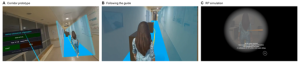
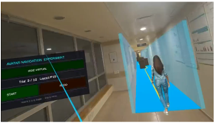
Figure 1. The walking-avatar prototype. (A) The corridor setup. (B) Following the guide around virtual obstacles. (C) Viewing the avatar through a simulated restricted visual field (RP simulation).
During our work with people with low vision, participants told us they were following the researcher walking ahead of them. Following another person offers cues about where to turn, how to pass an obstacle, and when to slow down. This observation motivated us to explore whether an avatar viewed through augmented reality glasses could provide similar guidance as people with low vision move through their surroundings.
Our earlier study examined whether people reading while walking with AR glasses could delegate some environmental monitoring to technology. The system detected approaching obstacles and used brief sounds to signal when attention was needed. The alerts helped people balance attention to the on-screen reading task with monitoring their surroundings. Supported by an AIRC SEED grant, the walking-avatar project extends this question to people with low vision: can technology take on part of the work of monitoring the environment and guiding a route, with feedback that is easy to follow?
Our corridor prototypes allow us to examine how a virtual guide’s movements communicate turns and changes in the path. Eye tracking and a simulation of restricted vision that follows the user’s gaze let us explore how the guide should move and appear when only part of the scene is visible. Alongside the avatar, we are investigating AI-based methods for identifying relevant obstacles and auditory cues for communicating information about them.
By examining what makes a virtual guide visible and easy to follow, we aim to develop design principles for navigation support that fits the user’s remaining vision. This work will inform when to use movement, visual cues, or sound to support more independent mobility.
Prior research: Context-Aware Alerts for Supporting Reading While Walking in Augmented Reality (Mayerowicz et al., 2026); Enhancing Obstacle Visibility with Augmented Reality Improves Mobility in People with Low Vision (Maman, Vol, and Szpiro, 2025).
Figure 1. The walking-avatar prototype. (A) The corridor setup. (B) Following the guide around virtual obstacles. (C) Viewing the avatar through a simulated restricted visual field (RP simulation).